The Card Foilia Kept
collector tale · 9 min read
account: Traditional collector tale; original witness unknown. · dated: Undated.
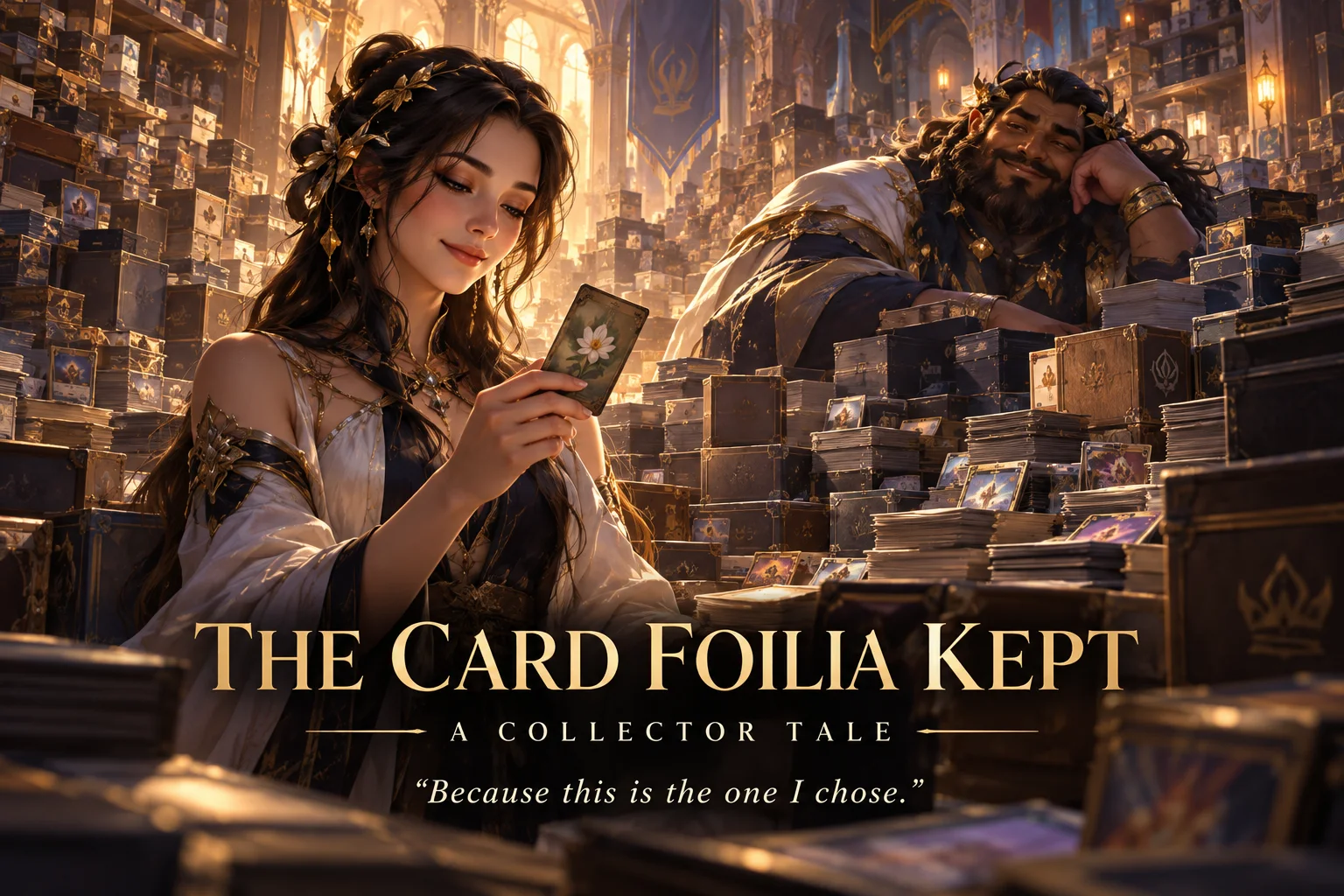
The card was somewhere beneath twelve thousand others.
Bulkazar considered this encouraging.
Foilia did not.
“You said you knew where it was.”
“I do.”
Bulkazar stood in the center of the hall with his hands resting comfortably on his stomach, surrounded by more cardboard than most kingdoms would have permitted indoors.
Boxes had been stacked against pillars. Loose cards occupied entire tables. Half-built decks sat beneath unopened sleeves. Commons leaned in crooked towers against bundles of tokens, damaged lands, discarded wrappers and the occasional card that somebody had placed somewhere “temporarily” several years before.
Foilia looked slowly around the room. “You know where it is,” she repeated.
“Yes.”
“And where is that?”
Bulkazar gestured broadly. “Here.”
She stared at him.
Bulkazar smiled. “This is considerably better than not knowing.”
Foilia closed her eyes. For a moment the hall caught the light around her and seemed almost beautiful.
Almost.
Then a stack of commons collapsed somewhere behind them. Bulkazar turned toward the sound. “Still sorting itself.”
Section IThe Search
The card Foilia had come for was rare even by her standards.
Not because there were prophecies attached to it. Not because it had survived some forgotten war. Not because the universe would fracture if somebody bent a corner.
It was simply difficult to find.
The illustration had been printed in a treatment used briefly and never repeated. The foil caught light along the edges of the image instead of across the whole surface. The border had been cut slightly narrower than later printings. The artist had changed one small detail in the background.
Bulkazar listened patiently while Foilia described it. When she finished, he looked at the mountains surrounding them.
“So.”
“Yes?”
“It is rectangular.”
Foilia folded her arms. “That is what you took from that?”
“It helps.”
“It has a silver edge.”
“So do several thousand things in this room.”
“A moon behind the figure.”
“Better.”
“The second printing changed the moon.”
“To?”
“A lantern.”
Bulkazar nodded gravely. “Now we are hunting cardboard with astronomy.”
Foilia began searching without answering. Bulkazar waited until she had turned away before smiling.
She approached the piles differently than he did.
Foilia looked at the face of every card. Not merely the name. Not merely the mark in the corner. She looked.
A sword angled strangely through rain. A dragon painted in colors the printer had almost failed to reproduce. A portrait where the expression mattered more than the effect written beneath it. A city visible through the gap between two characters.
There were details hidden everywhere, and Foilia had long ago learned that most people stopped seeing them the moment somebody told them what the card was worth.
Bulkazar, meanwhile, sorted almost without looking.
One copy. Two. Three. Seven.
Useful. Damaged. Someone would want that. Wrong box. Definitely wrong box.
Foilia watched him return a plain card to a stack beside his chair. “You didn't even look at it.”
“I have copies.”
“That doesn't answer my point.”
“I have looked at it before.”
“You know that isn't what I mean.”
Bulkazar picked the card up again and studied it. He tilted it left. Then right. Then upside down.
Foilia waited.
“Still the same card.”
She sighed.
He placed it carefully back in the stack.
Section IIWhat People Call Beautiful
They searched for some time.
Eventually Foilia lifted a card from one of the boxes. Light moved across its surface in layers. The figure in the artwork stood beneath a sky painted in violet and gold, their cloak breaking into tiny fragments of foil as it reached the border.
Foilia's expression changed. It was slight.
Bulkazar noticed. “Beautiful?”
“Yes.”
“Expensive?”
“Probably.”
“Useful?”
She turned the card over. “No.”
Bulkazar held out his hand. Foilia gave it to him.
He studied the card. Then placed it into a small pile beside him.
Foilia frowned. “What pile is that?”
“Things people will ask for.”
“You don't like it?”
“I didn't say that.”
“You looked at it for three seconds.”
“I only needed two.”
“And?”
Bulkazar shrugged. “Beautiful.”
Foilia waited. “That is all?”
“Must there be more?”
Her expression softened despite herself. “No.”
Bulkazar continued sorting.
After a moment Foilia said, “There usually is.”
He looked at her.
She had already returned to the box.
Section IIIThe Card
Foilia found it several hundred cards later.
Not the card she had come for. Another one.
It was common. There were at least five copies visible in the same row.
The illustration showed a pale flower growing through a crack in a stone wall. Nothing else.
No warrior. No goddess. No explosion of light. No impossible creature emerging from the sea. Just a flower and old stone.
The card in Foilia's hand was not even the cleanest copy. One edge had softened from use. The surface had lost a little of its finish. A corner was slightly bent.
She turned it once in the light. Then, without thinking, ran her thumb gently along the worn edge.
Bulkazar stopped sorting. “You still do that.”
Foilia looked up. For the first time since entering the hall, neither of them smiled.
Then she looked back at the card. “You still notice.”
Bulkazar's hands returned to the pile. “So it seems.”
Foilia said nothing more. Neither did he.
Section IVEverything
She continued holding the card. Eventually Bulkazar noticed that she had not put it back.
“You are aware there are four cleaner copies beside it.”
“I am.”
“One of them appears nearly untouched.”
“I can see that.”
“Would you like me to point to it?”
“No.”
Bulkazar considered this. “Excellent. I was worried your vision had become selective.”
Foilia glanced at the room around them. “And yours hasn't?”
“I see everything.”
“That,” she said, “is exactly the problem.”
Bulkazar raised an eyebrow.
Foilia placed the worn card on the table between them. “You keep everything.”
“Yes.”
“You say that as though it is automatically a virtue.”
“I have found it preferable to throwing everything away.”
“I didn't say throw everything away.”
“Then we agree.”
“No, we don't.”
Bulkazar sat back. This was clearly more interesting than sorting.
Foilia looked toward the endless boxes. “You keep a card because someone may need it. Or because it belongs to a set. Or because there are only three copies. Or because there are three hundred.”
“Four hundred and twelve.”
“That was not a challenge.”
“It sounded approximate.”
She ignored him. “If nothing is ever passed over, then choosing stops meaning anything.”
Bulkazar's smile faded just slightly. “You think I don't choose?”
“I think sometimes you refuse to.”
The hall seemed quieter.
Foilia picked up the worn card again. “You can keep something without caring for it.”
Bulkazar looked at the card. Then at her. “And you can admire something without understanding it.”
Foilia's eyes narrowed.
There it was. Not anger. Recognition. The kind of irritation that exists only between people who know where the other keeps their sharpest arguments.
Bulkazar leaned forward. “You know what happens when enough people are told the same thing is ordinary.”
Foilia waited.
“They stop looking.”
His gaze moved toward the surrounding boxes. “They stop reading the name. They stop seeing the art. They stop asking whether it is useful. They stop asking who owned it before them.”
He touched one finger to the top of a stack. “They learn the category first.”
Foilia looked again at the flower in the wall.
Bulkazar continued. “Common.”
His finger moved to another pile. “Bulk.”
Another. “Worthless.”
He leaned back. “Very efficient.”
Foilia was quiet.
Then she held up the card she had admired earlier—the violet-and-gold foil. “And when something truly is beautiful?”
Bulkazar answered immediately. “Then it is beautiful.”
“When it is genuinely scarce?”
“Then it is scarce.”
“When ten thousand people want one card?”
“Then you will have ten thousand people behaving very strangely.”
Foilia laughed despite herself.
Bulkazar's smile returned. “There you are.”
Section VOne of These
A visitor entered the hall sometime later. Young, though not a child. They carried a deck box held together at one corner with tape.
Bulkazar greeted them as though people routinely wandered into halls containing enough cards to alter the load-bearing calculations of the floor.
The visitor placed a short list on the table. “I'm missing one.”
Bulkazar read it. “Third row. Blue box. Near the bottom.”
Foilia looked at him. “You knew that?”
“Of course.”
The visitor returned carrying several copies of the same card. They spread them across the table.
The cards were inexpensive. Plain. The artwork differed slightly between printings.
The visitor inspected each one. Then chose the oldest-looking copy.
Bulkazar pointed to a cleaner one. “That one's in better condition.”
“I know.”
“The corner on yours is whitening.”
“I know.”
Bulkazar nodded.
Foilia watched. “Why that one?” she asked.
The visitor looked surprised that Foilia had spoken to them. They glanced down at the cards. “I like this picture better.”
Foilia looked at Bulkazar.
Bulkazar was suddenly deeply occupied with moving a stack approximately three centimeters to the left.
The visitor paid almost nothing for the card and left smiling.
Foilia waited until the doors had closed. “You enjoyed that.”
“No.”
“You absolutely did.”
“It was a transaction.”
“You moved the same pile three times.”
“It had not found its proper location.”
Foilia looked at him.
Bulkazar finally smiled. “Perhaps a little.”
Section VIWhat She Came For
It was nearly evening when Bulkazar froze. Foilia noticed because Bulkazar rarely stopped moving entirely.
His hand disappeared into a box beneath the table. He removed a card.
Silver along the border. The figure beneath the moon. Not the lantern.
The light touched the card and seemed to travel around the illustration rather than across it.
Foilia stopped.
Bulkazar held it up between two fingers. “This?”
She crossed the room quickly. He handed it to her.
The moment was quieter than he had expected.
Foilia examined the surface. The corners. The back. Then the image. Her thumb hovered near the edge but did not touch it.
“There you are,” she said.
Bulkazar watched her. “That is all?”
Foilia looked up. “What were you expecting?”
“I don't know. More light.”
“It has enough.”
“Music?”
“No.”
“A declaration?”
“To whom?”
Bulkazar gestured toward himself. “I am available.”
Foilia laughed. Then carefully placed the card into a protective sleeve she had brought with her. Another rigid case followed.
Bulkazar watched the layers accumulate. “Do you intend for anyone to see it again?”
“Yes.”
“Good. I was beginning to worry you were building it a tomb.”
She ignored him. When she finished, she placed the protected card safely inside her case.
Then Bulkazar noticed the other card was still in her hand. The flower. The cracked wall. The bent corner.
“That one belongs here.”
Foilia glanced at it. “Did.”
Bulkazar tilted his head. “Did?”
“Past tense.”
“You have several copies already?”
“No.”
“Completing a set?”
“No.”
“Deck?”
“No.”
“Then I have questions.”
“You always do.”
“Usually excellent ones.”
Foilia began walking toward the doors.
Bulkazar reached into the box and retrieved another copy of the same card. Clean edges. Flat surface. Almost untouched.
“Foilia.”
She turned.
He held it up. “If you insist on stealing from me, take the better one.”
“I am not stealing.”
“You have not paid.”
“You are a god of bulk.”
“This does not constitute a pricing policy.”
He crossed the room and offered her the clean copy.
Foilia looked from one to the other.
Same card. Same text. Same flower. Same wall.
One nearly perfect. One worn by hands neither of them could identify.
She returned the clean copy to him. “No.”
Bulkazar looked at the worn one. “Why?”
Foilia considered the question longer than the question seemed to deserve.
Then: “Because this is the one I chose.”
Bulkazar became very still. For a moment, whatever answer he might normally have made did not come.
Foilia noticed. She smiled faintly. Then left.
Section VIIAfter
Bulkazar stood alone in the hall. The evening light moved slowly across the stacks.
He returned to the table. He picked up the clean copy Foilia had rejected.
The flower grew through the same crack. The wall was the same wall. The card was, by every practical measure, better.
Bulkazar looked toward the doors. Then at the card.
“Ridiculous,” he said.
He returned to sorting.
Useful. Duplicate. Damaged. Someone will want that.
Keep. Keep. Keep.
Eventually another copy of the flower appeared. Bulkazar's hand paused above the usual pile.
He considered it.
Then placed the card somewhere else.
End of Chronicle II
Some things become precious because they are scarce.Others become scarce because someone refuses to let them go.