The First Printing
On Ink, Intention, and the First Thing Kept
sacred canon · 4 min read
account: Traditional Church account; original witness unknown. · dated: Traditionally dated to the First Printing.
Section IBefore the Pull
Before there were collections, there were objects.Before there were decks, there were games.Before there were chase cards, there was nothing to chase.Cardboard existed.Ink existed.Stories existed.They simply had not yet been bound together.
The oldest account does not tell us who conceived the first card.It does not name the builder of the press.It does not explain why one printed piece should differ from another.The text appears remarkably unconcerned with these questions.Later scholars were considerably less disciplined.†
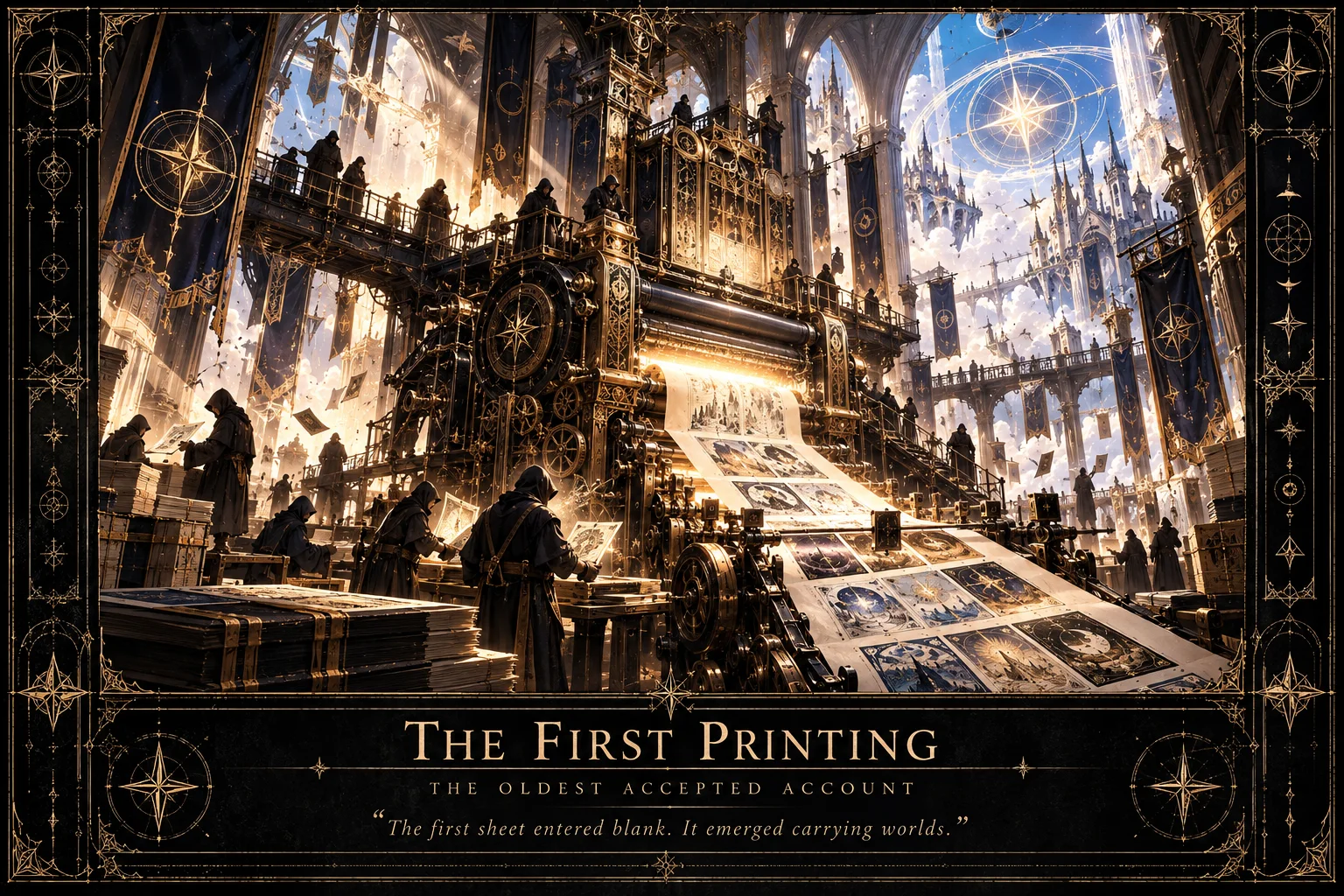
The account begins instead with the machine.Its rollers were said to shake the floor.Its plates carried images the account describes only briefly.Into it entered a blank sheet.From it emerged worlds.Thus began what the Church remembers as the First Printing.
- †Later traditions disagree on whether the press was constructed specifically for the First Printing or merely became important because of it. Sacred Canon does not settle the question.
Section IIInk Meets Intention
The earliest cards were crude by later standards.There were no alternate treatments.No serialized numbers.No collector boxes.No premium foil visible only when rotated seventeen degrees beneath the correct lamp.The Church considers this evidence that civilization was still developing.
But the cards possessed four things.An image.A name.A rule.And a place beside other cards.That proved sufficient.
When the first sheet was separated, the printers discovered something they had not printed.Preference.One person wanted the strongest card.Another wanted the rarest.Another preferred the artwork.Another cared only for the card that completed something else.And one held a card for several minutes before admitting:“I simply like this one.”
The cards were made alike in material.They did not remain equal in meaning.This distinction would cause considerable trouble.
Section IIIThe First Card Kept
Among those present was the figure later remembered as the First Collector.The oldest account gives no birth name.It describes no title.At this point in the story, the First Collector was simply someone standing near a table.
When the finished cards were distributed, hands reached first for the brightest pieces.The First Collector waited.After the others had chosen, one card remained near the edge of the table.It was neither the strongest nor the rarest.The First Collector took it.
A printer asked:“Why that one?”The answer was:“Because I wanted it.”
Later theologians devoted several thousand pages to interpreting this sentence.The original account devotes four words.
Section IVThe First Disagreement
Once the cards had been distributed, the first argument began.One person placed a card upon the table.“It was made to be played.”Another carefully put theirs away.“Then mine was made to be kept.”A third refused to open what remained sealed.“Then some things are made to remain possible.”No one persuaded anyone.
They did not yet call themselves Players.They did not call themselves Collectors.There were no Orders.There were no creeds.There were simply three people looking at cardboard and seeing three different purposes.
Those who played discovered strategy.Those who kept discovered completion.Those who preserved the sealed discovered the remarkable human ability to own something specifically in order not to use it.All three insisted theirs was the sensible position.
The disagreement survived longer than any of them.
Section VThe Many
Not every card from the First Printing was immediately admired.Some appeared again.And again.And again.A few drew excitement.Others accumulated quietly.Before the day ended, the first pile had formed.
The first rare card was admired.The first common card was set aside.Both survived.
One worker began collecting the unwanted cards from the floor.The First Collector stopped them.“Those belong with the others.”The worker looked at the pile.“Nobody wants these.”The First Collector replied:“That is not the same thing.”†
This exchange later became popular among collectors attempting to justify storage containers whose contents they have not examined since moving house.Its doctrinal significance remains debated.
- †“That is not the same thing” has since been quoted by several collector traditions. Nothing in the earliest account indicates that the First Collector intended to found any of them.
Section VIThe First Prayer
Near the end of the day, one unopened pack remained.The people gathered around it.Nobody admitted to being particularly interested.Nobody left.
One player hoped for a card that completed a strategy.One collector hoped for the missing piece of a sequence.One trader hoped for something somebody else desired.The First Collector watched.
Immediately before the pack was opened, an unnamed witness whispered:“Please let it be the one.”The Church traditionally recognizes this as the First Prayer of the Pull.
The account does not record what the pack contained.This omission has irritated believers for generations.The statistical effect of the prayer is nevertheless well established:odds_affected: 0.00%actual_explanation: variance
Section VIIThe First Collection
By nightfall, the First Printing had already stopped being one thing.Some cards had been played.Some had been traded.Some had been protected.Some had been damaged.At least one had been given away.The cards had begun acquiring histories faster than anyone could record them.
The First Collector gathered the cards they had chosen and wrote their names onto a piece of scrap paper.There was no numbering system.No binder.No database.No market value.Only a list.It is traditionally regarded as the first collection record.
According to the account, someone looked over the list and asked:“When will it be finished?”The First Collector considered the question.Then answered:“I don't think that is the point.”
That answer is preserved.The list is not.
The Chronicle records one final sentence before ending:“A card may be common without being ordinary.”Later generations would argue endlessly over what the First Collector meant.The First Collector, as far as anyone knows, never explained.
End of Chronicle I
The first collection began with a choice.Everything afterward began with disagreement.