Incorrect. Do Not Discard.
collector tale · 10 min read
account: Traditional workshop account; original witness unknown. · dated: Undated.
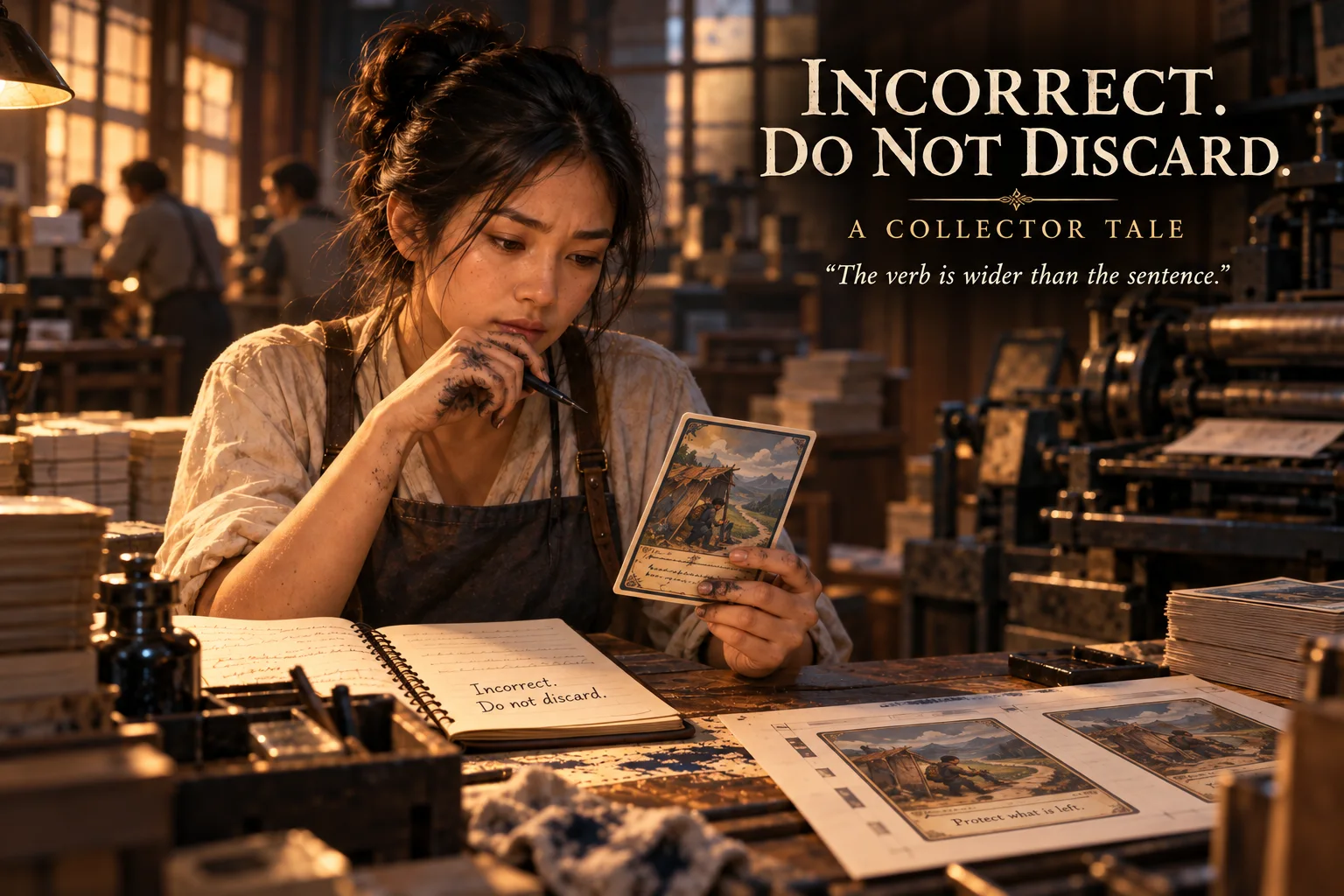
The press had been running badly since dawn. Mali knew this because the room sounded wrong.
Not louder. Wrong.
There was a soft hesitation between the turn of the rollers and the return of the plate, barely long enough to notice unless one had spent enough mornings beside the machine to know how it breathed.
Mali looked up from the proofs. “Again.”
The press operator did not hear her. The machine struck. Paper moved. Metal returned.
Mali raised her voice. “Again.”
The operator finally looked over. “What?”
“The return is late.”
He listened. The press struck. Paper moved. Metal returned. “No, it isn't.”
Mali stared at him.
He listened again. This time his expression changed. “A little.”
“Enough.”
He stopped the machine. Someone behind Mali groaned. They were already behind schedule.
She returned to the proof in her hands. The lower border of one card sat perhaps the width of a fingernail too close to its text. She marked it. Beside that, another card contained a punctuation mark she disliked. She marked that too.
The senior editor passed behind her. “You have found six things in twelve minutes.”
“Seven.”
He stopped. Mali pointed to the corner of the sheet. “The alignment.”
He leaned closer. Nobody spoke. Finally he said, “No one will notice that.”
Mali looked at him. “I noticed.”
He exhaled through his nose. “That is unfortunately true.”
Section IThe Proof
Mali liked proofs because proofs were honest. A finished card pretended it had always been that way. A proof admitted that somebody had chosen every part of it. The name. The image. The spacing. The wording. Even the empty places.
Especially the empty places.
On the table before her lay the newest translated printing of a familiar set. The illustrations were unchanged. The rules were unchanged. The cards would behave exactly as their counterparts did elsewhere. Only the language had moved. That was enough to cause trouble.
Mali worked from two columns. The source text sat on the left. The approved translation sat on the right. Her job was not simply to ask whether they contained the same information. She asked whether they did the same thing.
Sometimes that was easy. Draw. Discard. Shuffle. Choose.
Sometimes it was not. A word meaning hand could mean the cards someone held or the part of the body holding them. A word meaning field could describe a location, a condition or a place where something had been allowed to remain. Grammar behaved until cards required it to become machinery.
Mali enjoyed this. Other people found that concerning.
“You know,” said the editor beside her, “most people are pleased when two sentences mean roughly the same thing.”
Mali continued reading. “Most people do not print rules.”
“They communicate.”
“Approximately.”
He smiled. “There it is.”
Mali looked up. “What?”
“The expression you make when somebody says ‘approximately.’”
“I have no expression.”
“You have several.”
She returned to the proof. “All of them are accurate.”
The card that caused the problem was unremarkable. Its illustration showed a traveler repairing a small shelter after a storm. Torn cloth had been tied back into place. A few possessions remained beneath the roof. Nothing about the image was especially rare, beautiful or technically demanding.
The effect was simple.
Protect what is left.
Mali checked the source. Then the translation. Then the source again. Correct. She moved on.
Section IIThe Wrong Word
They discovered the error after lunch. A batch had already been printed for final inspection. Not distributed. Not packaged. Not approved. Just enough copies to make everybody annoyed.
Mali was standing near the cutting table when one of the assistants called her name. “Mali.”
She did not look up.
“Mali.”
“What?”
“Didn't you check this?”
That made her look. The assistant held out a card. The traveler. The torn shelter.
Mali took it. At first she saw nothing. Then she read the effect.
Pass on what is left.
Her stomach tightened. “Stop the press.”
The assistant laughed.
Mali didn't. “Stop it.”
The machine went silent for the second time that day. The senior editor arrived carrying the approved proof. Someone else brought the production plate. Mali placed all three beside one another. Source. Proof. Card.
The proof was correct. The plate was not. A substitution had slipped in while the production plate was being prepared. For now, the problem was obvious.
The editor tapped the defective card. “Wrong.”
“Yes.”
“The approved line is correct.”
“Yes.”
“We replace the plate.”
“Yes.”
He waited. Mali was still looking at the card.
“Mali.”
“I heard you.”
“Then why do you look disappointed?”
She frowned. “I don't.”
“You do.”
“I am looking.”
“At a mistake.”
“Yes.”
He waited another moment. “Should I be worried?”
“Probably not.”
“That answer did not help.”
Mali placed the defective card beside the proof.
Protect what is left.
Pass on what is left.
She read them again. “No,” she said finally.
“No what?”
“Nothing.”
The editor picked up the card. “Good. Because this one is wrong.”
Mali nodded. “I know.”
Section IIIThe Correction
The plate was replaced before evening. The source expression was not difficult in context. The traveler had survived a storm. Something remained. The instruction concerned maintaining what survived. Protect was right. The translation team agreed. Mali agreed.
The corrected wording was clearer. More faithful to the immediate function. Less likely to be misunderstood. It was, by every practical standard that mattered, better. That should have ended the matter.
It did not.
Mali found herself thinking about the rejected wording while checking an unrelated card.
Pass on what is left.
Wrong. She knew why it was wrong. The source did not instruct the player to transfer anything. No movement was required. No recipient existed. The defective sentence introduced an action the card did not perform. If a player followed the wording literally, they would misunderstand the effect.
Wrong.
Mali marked another proof. Then stopped.
Because the source word did contain movement. Not in this sentence. Not enough to justify the mistranslation. But it was there. The kind of secondary sense that dictionaries placed underneath the main definition and translators remembered only when context demanded it.
To maintain. To continue. To cause something to remain by taking it onward.
Mali hated that. Not the language. The fact that the mistake had found something real.
“You are doing it again.”
Mali looked up. The senior editor was standing at the other side of the table.
“Doing what?”
“Arguing with something that cannot hear you.”
“I am reading.”
“You have been reading the same two lines for ten minutes.”
“Then I've been thorough.”
He pulled out the chair opposite her. “Explain.”
“There is nothing to explain.”
“Mali.”
She slid the two versions across the table.
He read them. “Protect what is left.”
“Yes.”
“Pass on what is left.”
“Yes.”
“The second is incorrect.”
“Yes.”
He looked up. “Then?”
Mali tapped the source. “The verb is wider than the sentence.”
“So?”
“The correct translation narrows it.”
“All translations narrow something.”
“I know.”
“That is the job.”
“I know.”
He leaned back. “Then what are we arguing about?”
Mali looked at the two cards. “We aren't.”
“You appear to be losing.”
That almost made her smile. Almost.
She pointed to the approved wording. “This tells the player exactly what the card requires.”
“Good.”
She pointed to the defective wording. “This doesn't.”
“Also good.”
“But the wrong one…”
She stopped. The editor waited. Mali disliked sentences that were not ready. She started again. “The correct version tells you how something survives.”
He looked at her. “And the wrong one?”
Mali stared at the card. “It assumes survival requires somewhere to go.”
The editor was quiet. Then he picked up the defective copy. “That is interesting.”
Mali looked at him. “It is still wrong.”
“Yes.” He placed it back on the table. “Those are allowed to be separate facts.”
Section IVWithdrawn
The instruction came the next morning. The defective batch was to be withdrawn. The wrong plate had already been marked for disposal. Usable sheets would be recycled where possible. Individual cut cards would go into the defective stock bin. Normal procedure.
Mali approved the corrected print before noon. The press sounded right again. She checked the alignment. The punctuation. The effect.
Protect what is left.
Perfect.
“Well?” asked the press operator.
Mali turned the card beneath the light. “Good.”
“Just good?”
“The lower border could move half a measure.”
He stared at her.
Mali let him stare. Then she placed the card down. “Good.”
The operator smiled. “I'll take it.”
The defective stock bin stood beside the cutting table. Mali passed it three times that afternoon.
The first time, she did nothing. The second time, she stopped. Inside lay bent proofs, cards with color shifts, misaligned backs, torn stock and several copies of the traveler.
Pass on what is left.
She kept walking.
On the third pass, she picked one up. Not dramatically. Nobody gasped. No bell rang. Nobody was watching. She simply held it.
The printing was clean. The error was entirely linguistic. That somehow made it worse. A badly cut card could be seen. A wrong color could be measured. This looked correct until someone read it carefully.
Mali turned toward her desk. Stopped. Turned back.
She should put it into the bin. The run was defective. The correction had been made. There was no production reason to preserve the error. She looked again at the line.
Pass on what is left.
Then she slipped the card between the pages of her notebook.
Mali disliked the sensation immediately. Not guilt. Imprecision. She had violated a process without documenting why. That was intolerable.
She opened the notebook again. Under the card she wrote:
Incorrect. Do not discard.
She considered adding an explanation. Did not. Closed the book.
Much better.
Section VThe Perfect Version
The corrected cards entered normal production two days later. Mali inspected the first full batch. Every line matched the approved translation. The troublesome border had been adjusted. The ink density was consistent. The registration held. The card with the traveler now read exactly as it should.
Protect what is left.
The senior editor placed a finished copy beside Mali's hand. “Better?”
She read it. “Yes.” There was no hesitation.
The editor watched her carefully.
Mali looked at him. “What?”
“I expected resistance.”
“Against the correct version?”
“Yes.”
“Why?”
He glanced toward her notebook. Mali closed it.
The editor smiled. “You know, one day somebody is going to discover that being interesting and being correct are not the same thing.”
“I discovered that yesterday.”
“And?”
“I dislike it.”
“Good.”
“Why good?”
“Because now you know.”
Mali examined the finished card one last time. “You say things like that when you have no useful answer.”
“It saves time.”
The corrected edition went forward. Work continued. Another card had a spacing problem. A title had been translated too literally. Someone had mislabeled a production sheet. The world remained full of errors requiring Mali's attention.
That helped.
Section VISomebody Else Reads It
A week later, an assistant borrowed Mali's notebook. Not intentionally. They had been comparing registration marks and grabbed the wrong one from her desk.
Mali noticed when she heard: “What is this?”
She looked over. The notebook was open. The defective card sat between the pages.
Mali crossed the room. “You took the wrong book.”
The assistant held up the card. “This got withdrawn.”
“Yes.”
“Why do you have it?”
“Give me the notebook.”
They read the line aloud. “Pass on what is left.”
Mali held out her hand. “It's incorrect.”
The assistant didn't return it yet. They looked at the illustration. The traveler beneath the repaired roof. “What does the correct one say?”
“Protect what is left.”
The assistant read the defective version again. “I like this one better.”
Mali frowned. “It is wrong.”
“I heard you.”
“It changes the instruction.”
“I know.”
“Then why do you prefer it?”
The assistant shrugged. “Sounds like the traveler is leaving.”
Mali looked at the card. “He isn't.”
“How do you know?”
“The illustration.”
The assistant turned it toward her. “The road is behind him.”
“That does not mean he is leaving.”
“It also doesn't mean he isn't.”
Mali stared.
The assistant smiled. “You hate this conversation.”
“Yes.”
They handed the card back. Mali took it.
The assistant pointed to the handwritten note beneath it. “Do not discard?”
“Yes.”
“Why?”
Mali looked down. She had prepared several answers to that question. None were ready. “Because it is incorrect.”
The assistant laughed. “That usually makes you throw things away.”
“Not this one.”
“Why?”
Mali closed the notebook. “Go back to work.”
“That means you don't know.”
“That means you should go back to work.”
The assistant walked away smiling. Mali remained at the table. She opened the notebook again.
Pass on what is left.
The assistant had seen departure. Mali had seen continuation. Neither interpretation was what the card actually said in its original context.
She found this deeply irritating. And, increasingly, interesting.
Section VIIDo Not Discard
By the end of the month, the error had become ordinary. The production log contained a short entry.
Translation corrected. Defective run withdrawn.
That was enough. The corrected cards went into packs. Players used them. Collectors stored them. Some would be damaged. Some would be forgotten. Some would survive because somebody happened to put them somewhere safe.
Mali continued working. Another set of proofs was already waiting, and she was late finishing them.
Before leaving, Mali opened her notebook. The defective card was still there. The traveler stood beneath the repaired shelter. The words remained wrong. She reread the note she had written beneath it.
Incorrect. Do not discard.
Mali considered adding something else. Perhaps an explanation. Perhaps the source definition. Perhaps the correct wording. She picked up her pen. Then put it down again.
For once, she allowed a thing to remain insufficiently explained. She closed the notebook and took it home.
End of Chronicle III
A correction can set the sentence right.A mistake can leave the question open.